We may earn a commission when you buy through links on this page, at no extra
cost to you. As an Amazon Associate I earn from qualifying purchases.
Countertop describes where a filter sits, not what it does, and the category splits in two. For chlorine and taste on municipal water, the Brondell H630 Cypress is the one whose maker names a certifying body rather than a standard, and the iSpring CKC2 does the same job for half the money with more owner ratings than everything else here combined. For dissolved solids, fluoride or nitrate, no carbon filter will help and the iSpring RCD100 puts a reverse osmosis membrane on the worktop without plumbing.
Which half you need is a question about your water rather than your budget. Municipal supplies publish an annual report, and it tells you whether you have a taste problem or a chemistry one. Buying reverse osmosis for a chlorine smell is the most expensive mistake in this category, and buying carbon for a nitrate result does not solve it at all.
Last updated
The split that decides it
Every product on this page sits on a worktop and needs no plumbing. That is
the only thing they have in common, and search engines group them by it
because it is the word people type. What actually separates them is whether
they strain and adsorb, or whether they push water through a membrane.
Type
What it costs
Deals with
Does not touch
How it fits
Carbon, on the tap
The lower half of the category
Chlorine, taste, odour, sediment and rust
Dissolved solids, fluoride, nitrate, hardness
A diverter valve on the spout. Nothing is cut or drilled, and nothing goes to waste.
Reverse osmosis, on the worktop
Roughly five times the carbon units
Everything carbon does, plus dissolved solids, fluoride, nitrate and PFAS
Nothing much, at the cost of space and waste water
You fill a tank, it makes water into a second tank. Still no plumbing, but it takes real worktop space.
Your water report answers this before you spend anything. A
municipal supplier publishes one every year and it is free. If the numbers
you care about are chlorine and taste, the top of that table is the whole
answer and the bottom half is money you do not need to spend. If it shows
nitrate, fluoride or high dissolved solids, the top half will not move them
at all.
The filters
★ Best overall
Brondell H630 Cypress Countertop Water Filter System
Most kitchens on municipal water, and the one with a certification you can look up
The most thoroughly certified thing on this page, and the certification is worth reading rather than counting. Under NSF/ANSI 401, the emerging contaminants standard, its listing carries all sixteen claims that standard contains: pharmaceuticals, hormones, pesticides, bisphenol A and microplastics. Most products certified to 401 hold a few of those claims, because each one is granted on its own test. This one holds the set.
Checked against Water Quality Association listings
listed as Cypress H630 ·
checked 2026-08-06 WQA Gold Seal. Certified under NSF/ANSI 42 for aesthetic chlorine, nominal particulate class I and taste and odour; under 53 for cyst, turbidity and VOC as chloroform; and under 401 for all sixteen claims that standard contains, microplastics among them.
What we liked
Certified for microplastics reduction, which is a named claim under NSF/ANSI 401 and the only product on this site verified to hold it
Holds all sixteen claims NSF/ANSI 401 contains, where most certified products hold a handful of them
Certified by WQA under three standards, so the aesthetic, health and emerging contaminant claims are separately tested rather than bundled
No plumbing, no power and no drain line
Worth knowing
Carbon filtration, so dissolved solids and fluoride pass through the way they do on any filter of this type
455 ratings is a tenth of the evidence behind the iSpring, which costs half as much
Cartridges are proprietary, so the running cost is whatever Brondell sets it to
Reverse osmosis without a plumber. You fill a tank, it makes water into a second tank, and nothing is cut or drilled, which is the whole point on a worktop. The membrane is the same technology as the under-sink systems, so unlike the carbon units on this page this one reaches dissolved solids and fluoride. The cost is the space it takes and the tanks somebody has to keep filling.
Brand
iSpring
Stages
5-stage
Flow rate
Instant hot, fills from a jug
Warranty
1 year
CertificationNone stated
What we liked
A real reverse osmosis membrane, so dissolved solids, fluoride and nitrate are addressed rather than passed through
Fills its own tank from a jug, so it needs no supply line, no drain connection and no hole in the worktop
Instant hot dispensing, which is what makes a countertop unit replace a kettle rather than sit beside one
A fifth cheaper than the Waterdrop A2 for the same core job
Worth knowing
Takes a large footprint on the worktop, which is the trade for not plumbing it in
Still produces waste water, and on a countertop unit that means somebody empties a tank
Ratings are thin at 267, and at 4.1 they are the weakest of the iSpring systems we carry
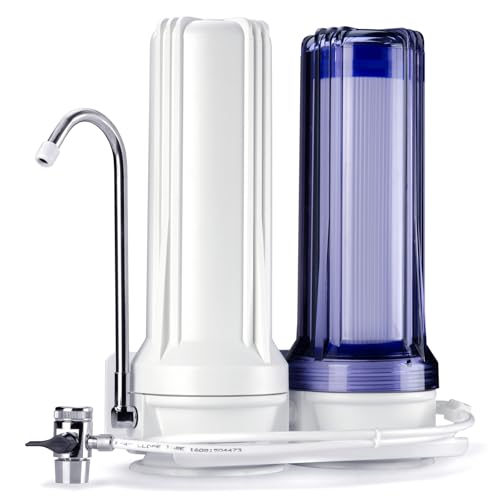
The one to buy if the water is municipal and the complaint is taste. It clamps to the tap through a diverter valve, uses two full-size cartridges instead of the small pucks most countertop units take, and has been bought and rated more than everything else on this page put together. What it does not do is chemistry beyond carbon, so anything dissolved needs one of the membrane systems below.
Brand
iSpring
Stages
2-stage
Capacity
8,000 gal
Flow rate
Diverter valve on the tap
Warranty
1 year
Size
Two 10 inch cartridges
CertificationNone stated
What we liked
Over 5,000 owner ratings at 4.6, which is more field evidence than the rest of this page combined
Fits any standard tap through a diverter valve, so there is no plumbing and nothing permanent
Two full-size 10 inch cartridges rather than the small pucks most countertop units use, so the service interval is long
Costs less than a sixth of the reverse osmosis units here and sends nothing to waste
Worth knowing
Carbon filtration, so dissolved solids, fluoride and nitrate pass through untouched
The diverter does not fit every modern pull-out or spray tap, which is the common reason for a return
iSpring states independent third-party testing to NSF/ANSI standards rather than certification, and those are different things
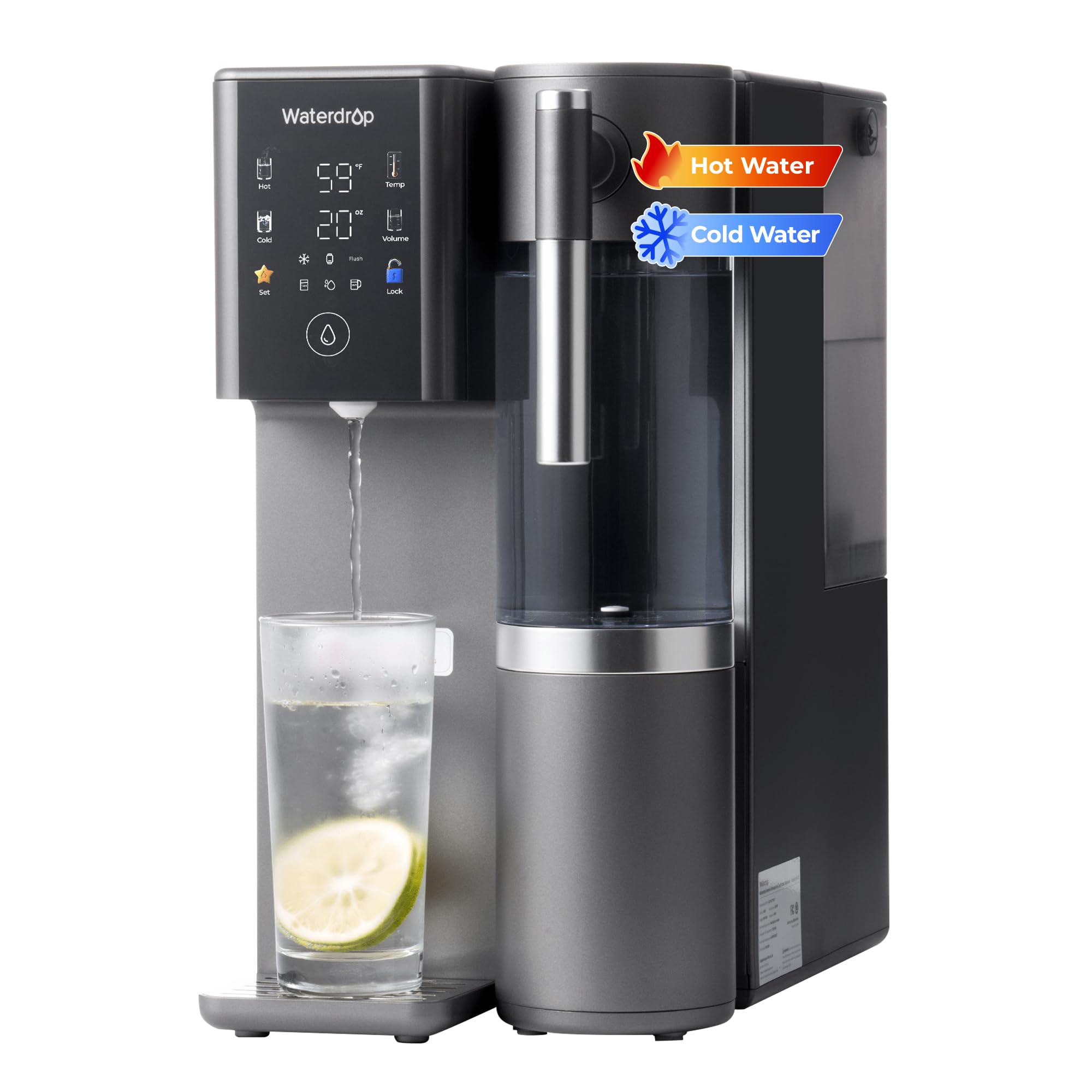
The most capable and the most expensive, and whether it is worth it turns on whether you want hot and cold water as well as filtered. As reverse osmosis it does what the iSpring RCD100 does. As an appliance it is replacing three things on the worktop, and the 4.0 average is the lowest on this page, which is worth weighing against the feature list.
Brand
Waterdrop
Stages
4-stage
Flow rate
Instant hot and cold, fills from a jug
Warranty
1 year
CertificationNone stated
What we liked
Hot and cold on demand, so it stands in for a kettle and a chilled jug as well as a filter
Reverse osmosis, so it reaches everything the two carbon filters on this page cannot
From the brand that certifies more of its under-sink range than anyone else we carry, which is a reason to take the engineering seriously
Worth knowing
The most expensive thing on this page and the lowest rated, at 4.0 across 376 ratings
No certification listed for this model, unlike several of the same brand’s under-sink systems
A heater and a chiller in one box are two more things that can fail than a filter has
Countertop filters advertise certification more loosely than any other
category we cover, and the wording repays reading closely. "Tested to
meet NSF/ANSI standards" names a standard and no certifying body,
and there is no listing behind it to look up. A certification names the body
that granted it, which means a public record exists with the model number in
it.
Four bodies certify drinking water treatment in North America: NSF,
WQA, IAPMO R&T and CSA. All four publish their listings. The
Brondell is the one here that names a body, and we read its record: WQA
lists the Cypress under NSF/ANSI 42 for aesthetic chlorine,
nominal particulate class I, taste and odour; under 53 for
cyst, turbidity and VOC; and under 401 for all sixteen
claims that standard contains, microplastics among them.
Search that database by model number, not by product name.
Brondell's reverse osmosis system is sold as the Circle and listed as
RC100, with no brand shown against it, so searching what is
written on the box finds nothing at all. Every certifier indexes by the
string the manufacturer registered, and it is rarely the one on the
listing.
Common questions
What is the best countertop water filter?
It depends entirely on what is wrong with your water, and the two halves of this category are not competing for the same job. If your water is municipal and the complaint is taste or chlorine smell, a carbon filter on the tap does that and there is no reason to spend more. If you have a test result showing dissolved solids, fluoride or nitrate, no carbon filter will touch those and you need a reverse osmosis unit, which costs several times as much on a worktop. Buying the expensive one for a taste problem is the most common mistake in this category.
Do countertop filters need plumbing?
No, and that is the reason the category exists. Carbon units clamp onto the tap through a diverter valve, which is a small collar you fit by hand. Countertop reverse osmosis units are filled from a jug and dispense into a second tank, so they need no supply line and no drain connection either. Both need nothing cut, drilled or permanently altered, which is what makes them the option for a rented kitchen.
Is countertop reverse osmosis as good as an under-sink system?
The membrane is the same technology and does the same job. The differences are practical rather than technical: a countertop unit takes a large footprint on the worktop, holds a limited amount of water at a time, and needs somebody to fill one tank and empty another, where an under-sink system is plumbed to the supply and to the drain and does all of that by itself. If you can plumb one in, an under-sink system is the better long-term buy at a similar price. If you cannot, the countertop version is not a compromise on water quality.
What is the WQA Gold Seal?
The Water Quality Association is one of the four bodies that certify drinking water treatment products in North America, alongside NSF, IAPMO R&T and CSA, and Gold Seal is its certification mark. A product carrying it has been tested against the relevant NSF/ANSI standard by WQA and its manufacturing plant is inspected. It is worth distinguishing from the much more common phrase "tested to meet NSF/ANSI standards", which names a standard but no certifying body and involves no listing anyone can look up.
How often do countertop filter cartridges need changing?
Carbon cartridges on a countertop unit typically run six months or a few thousand gallons, whichever comes first, and the practical signal is chlorine taste coming back. Reverse osmosis units have several stages on different schedules: sediment and carbon pre-filters roughly every six to twelve months, and the membrane itself every two to three years. Check the specific figures before buying, because on countertop units the cartridges are usually proprietary and the running cost varies more than the purchase price does.