We may earn a commission when you buy through links on this page, at no extra
cost to you. As an Amazon Associate I earn from qualifying purchases.
Whole house water filter replacement
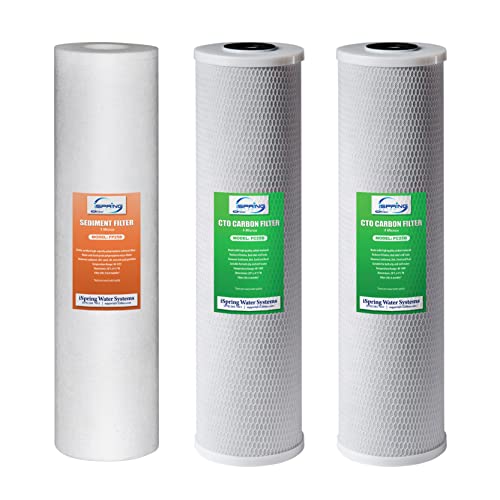
A whole house system is a sequence, not a set. Sediment goes in the first position, carbon behind it, and the third position decides what kind of system you own. For a standard 3-stage unit the yearly change is the F3WGB32B set, which is one box containing all three. Buying the cartridges separately costs more and puts the stages on three different schedules.
The order is not a detail. A carbon block fitted in the first position loads from the outside with grit and is ruined long before its media is spent, which spends the most expensive cartridge in the system protecting the cheapest. The housings are identical and nothing stops you fitting them the wrong way round.
Last updated
Which cartridge goes where
Every 20 by 4.5 inch housing takes every 20 by 4.5 inch cartridge, so the
system does not enforce its own design. This is the sequence these systems
are built around.
More carbon on city water, iron and manganese on a well
The position that decides whether the system is a city-water filter or a well-water one.
There is no certificate to check here
The other two pages in this cluster are built on a document: a system is
certified in one configuration, and the certifier publishes the cartridge
that configuration contains, so you can look up the part and know it keeps
the claim intact. That works for
reverse osmosis under
standard 58 and for
refrigerator filters under
42 and 53.
Whole house filtration is a category without a performance
certification to look up. Searching NSF for these systems returns
the manufacturer's reverse osmosis products and no whole-house model, which
is a real absence rather than a failed search, because the same query finds
their certified systems. So the facts worth comparing are the ones printed
on the cartridge: micron rating, media type, size and rated capacity. We
measured how the whole category describes its testing on
our certification survey.
The cartridges
Ordered by where they sit in the line rather than by rank, because a reader
here owns one system and needs the part for one position.
The annual set
iSpring F3WGB32B 3-Stage Whole House Filter Set
4.8 stars from 308 owner ratings
The annual change for the 3-stage systems, sold as one box. It contains a sediment cartridge and two carbon blocks, which is the configuration the WGB32B and the WCB32O ship in. Buying the set is the practical way to keep the stages on one schedule, because a system where the three cartridges were changed on three different dates is a system nobody can remember the state of.
Fits
iSpring WGB32B and WCB32O, and any 3-stage 20 x 4.5 inch housing
Replace
All three together every 6 to 12 months
What we liked
One box covers the whole system, which is the only way to keep three stages on the same schedule
Works out cheaper than buying the three cartridges separately
Standard 20 x 4.5 inch sizes, so the housings are not proprietary and the parts stay easy to source
Worth knowing
Ships all three on one date, so a sediment stage that needs changing at three months on a dirty supply still has to be bought on its own
The set is built for the sediment and carbon configuration, so an iron and manganese system needs the FM25B in the third position instead
iSpring FP25B Sediment Cartridge, 20 x 4.5 inch, 5 Micron
4.7 stars from 696 owner ratings
The first cartridge the water meets and the one that decides how long everything downstream lasts. Sediment loads a carbon block from the outside in, so a spent sediment filter does not just stop catching grit, it starts shortening the life of the two cartridges behind it. It is also the cheapest part in the system, which makes running it long the most expensive saving available.
Fits
Every 20 x 4.5 inch whole house housing, in the first position
Replace
Every 6 months, or 3 on sediment-heavy well water
What we liked
The cheapest cartridge in the system and the one that protects every stage behind it
5 micron is the right compromise for most supplies, fine enough to catch grit without choking the flow rate
Changing it on time is what makes the carbon stages last their full interval
Worth knowing
On a well producing sand it can need changing at three months, which is twice the schedule the rest of the system runs on
A pleated cartridge cannot be washed and reused, unlike a spin-down screen upstream of it
iSpring FC25B CTO Carbon Block Cartridge, 20 x 4.5 inch
4.7 stars from 2,214 owner ratings
The cartridge that removes chlorine, taste and odour, which is what a whole house system is bought for on municipal water. A carbon block is compressed rather than loose, so water cannot find a channel through it and arrive untreated, and that is the practical difference between a block and a cheaper granular cartridge in the same housing.
Fits
The second and third positions of a 20 x 4.5 inch system
Replace
Every 6 to 12 months
What we liked
The stage that does the work most people bought the system for, which is chlorine, taste and odour
The most-reviewed cartridge in this range by a wide margin
A carbon block rather than loose granular carbon, so the water cannot channel through a low-resistance path and skip the media
Worth knowing
Runs its interval on the assumption the sediment stage in front of it is being changed, and fails early if it is not
Chlorine taste coming back is the only practical signal, and by then it has been past its best for a while
iSpring FM25B Iron and Manganese Cartridge, 20 x 4.5 inch
4.5 stars from 637 owner ratings
The third stage of the WGB32BM, and the one that makes it a well-water system rather than a city-water one. Iron and manganese are the problem municipal supplies have already solved and private wells have not, which is why a standard carbon system has no answer for the orange staining. Fitting this in the third position is what converts the platform.
Fits
The third position of the iSpring WGB32BM, replacing a carbon block
Replace
Every 6 to 12 months, depending on iron load
What we liked
The cartridge that separates a well-water system from a city-water one, and the reason the WGB32BM exists
Catalytic media works by oxidising iron rather than being consumed by it, so it outlasts the greensand alternatives
Drops into the standard third position, so no plumbing changes are needed to convert a system
Worth knowing
The most expensive cartridge in the range, at roughly three times the sediment stage
Does nothing useful on municipal water, where iron and manganese have already been dealt with
Pressure is the signal, not the calendar. A sediment
cartridge fills from the outside and restricts flow long before it stops
catching anything, so the tap furthest from the system losing noticeable
flow is the most reliable practical reading a whole house system gives you.
Change the sediment stage first and see whether the pressure returns before
suspecting the carbon.
Carbon gives no such warning. Chlorine taste returning is the only everyday
signal, and by the time it is obvious the stage has been past its best for
a while. That is the argument for changing the carbon on a date rather than
on a symptom, and for buying the set so the dates stay together.
Common questions
How often should I change a whole house water filter?
Every 6 to 12 months for the carbon stages, and every 6 months for the sediment cartridge, or every 3 on a well that produces sand. The manufacturer publishes one interval for the whole system, which is convenient and wrong, because the stages wear at completely different rates. The practical signal is pressure: when the tap furthest from the system loses noticeable flow, the sediment cartridge is loaded.
Does the order of the cartridges matter?
Yes, and it is the most common way to get a whole house system wrong. Sediment goes in the first position, carbon behind it. A carbon block fitted first loads from the outside with grit and is ruined long before its media is spent, which wastes the most expensive cartridge in the system to protect the cheapest. The housings are identical and the cartridges are interchangeable, so nothing physically stops you fitting them the wrong way round.
Are whole house filter cartridges certified?
Whole house filtration is a category without a performance certification to look up, unlike reverse osmosis under standard 58 or refrigerator filters under 42 and 53. Searching NSF for these systems returns their reverse osmosis products and no whole-house model. So the facts worth comparing are the ones on the cartridge itself: micron rating, media type, physical size and rated capacity. Our research page covers how the category describes its testing.
Can I use a different brand of cartridge?
Usually yes, because 20 by 4.5 inch and 10 by 4.5 inch are industry-standard sizes rather than proprietary ones, and that is a genuine advantage of these systems. What changes between brands at the same size is the micron rating and the media, so match those rather than the label. A 1 micron sediment cartridge in place of a 5 micron one will filter more finely and drop your pressure noticeably.
Why is my water pressure dropping?
A loaded sediment cartridge, almost always, and it is the system telling you the first stage has done its job. Pressure loss at the furthest tap is the most reliable practical signal on a whole house system, because the cartridge fills from the outside and restricts flow long before it stops catching anything. Change the sediment stage first and see whether the pressure returns before suspecting the carbon.