We may earn a commission when you buy through links on this page, at no extra
cost to you. As an Amazon Associate I earn from qualifying purchases.
Well water is treated in an order, not solved by one product. Grit first, then iron and manganese, then taste and chemistry, then bacteria. For a well that stains fixtures, the core purchase is the iSpring WGB32BM, whose third stage is catalytic iron and manganese media. For grit, scale or a sulphur smell instead, the iSpring WGB32B-KDS adds a flushable spin-down and a KDF stage across 250,000 gallons.
Get a lab test before you buy anything. A well has no utility publishing an annual report, so which of those four problems you have is unknown until somebody measures it, and a $50 test decides which of these systems is the right one. If the test finds coliform, filtration is not the answer to that part and ultraviolet disinfection is.
Last updated
Test the water first
On municipal water you can read your supplier's annual report and know what
you are dealing with before you spend anything. A private well has nobody
behind it doing that, so the composition is unknown until you measure it,
and every recommendation below depends on the result.
A state-certified lab test runs roughly $50 to $200. The EPA
recommends testing a private well every year for coliform bacteria, nitrate,
total dissolved solids and pH, and adding iron, manganese, hardness and
hydrogen sulphide if you are about to buy treatment. Your state or county
health department publishes the list of certified labs, and many run a
subsidised first test.
The test also tells you what not to buy. The most expensive
mistake on a well is fitting an iron stage to water with no iron in it, or a
UV lamp to water with no bacteria, and both are easy to sell to somebody who
has not measured.
The order things go in
Each stage exists to protect the one behind it, which is why the sequence is
not negotiable and why the cheapest item is the one that goes first.
Stage
The problem
What treats it
Why here
1. Grit
Sand, silt and rust flakes, which almost every well produces
A flushable spin-down screen at 50 to 100 microns
It costs the least and protects everything behind it. Skip it and you replace cartridges every two months instead of every twelve.
2. Iron and manganese
Orange staining on fixtures and laundry, a metallic taste, black specks
Catalytic media, usually as the third cartridge in a whole-house system
This is the stage that separates a well filter from a city-water filter. Municipal supplies have already dealt with it, so a standard carbon system has no answer for it at all.
3. Taste, chemistry and scale
Hydrogen sulphide (rotten eggs), hardness and scale, organic chemicals
Carbon block, KDF for sulphur, polyphosphate for scale
KDF is the part that matters on a well, because plain carbon does very little about hydrogen sulphide. Real hardness needs a softener, which is a separate machine.
4. Bacteria
Coliform or E. coli in a lab test
Ultraviolet disinfection, fitted last
The only item on this list that is a health risk rather than a nuisance. UV goes last because light has to reach the organisms, and cloudy water shields them.
Hardness sits outside this list on purpose. Scale is a real well problem and
a cartridge filter does not solve it: the polyphosphate stage in the
WGB32B-KDS sequesters calcium and magnesium, which slows scale, and genuinely
hard water needs an ion-exchange softener, which is a separate machine with a
salt tank.
The systems
Both of these are scored on the same four inputs we use everywhere: owner
ratings weighted by volume, certification, filter cartridges and warranty,
measured against what is achievable in this category. The formula is
published on how we rate. They answer different
questions, so read what each is for before you read the number.
★ Most complete
iSpring WGB32B-KDS+WSP50 4-Stage Whole House System with Spin Down
Wells with grit, scale or a sulphur smell rather than rust staining
The most complete arrangement we can buy for a well, and the only one that starts where a well should start: a flushable spin-down screen catching sand and grit before anything expensive sees it. Behind it sit polyphosphate anti-scale, a GAC and KDF stage, and a carbon block. KDF is the part worth the money on a well, because it is what addresses hydrogen sulphide, the rotten-egg smell that plain carbon does not touch. What it does not have is an iron stage.
Brand
iSpring
Stages
4-stage
Capacity
250,000 gal
Flow rate
15 GPM
Warranty
1 year
Size
27 x 22 x 17 inches
CertificationThird-party tested, per manufacturer
What we liked
Four physical filtration units rather than three: a flushable spin-down screen ahead of the usual cartridge stack, which is the arrangement well water actually wants
The KDF stage is the one that addresses hydrogen sulphide, the rotten-egg smell no plain carbon filter fixes
Rated 250,000 gallons, two and a half times the WGB32BM, so the running cost per year is the lowest here
The FWDS150K polyphosphate stage sequesters calcium and magnesium, which slows scale without a softener or a salt bag
The spin-down is flushed rather than replaced, so grit costs you a tap turn instead of a cartridge
Worth knowing
No iron or manganese stage, so a well that stains needs the WGB32BM instead of this or the media swapped in
The largest and heaviest system here at 63 lb assembled, and it needs a wall run of about 27 inches
The default answer for a well that stains. Iron and manganese are what mark fixtures orange and put a metallic edge on the taste, and a standard whole-house carbon system ignores both because municipal water has already dealt with them. This is the WGB32B platform with its third stage swapped for catalytic iron and manganese media. If your water leaves rust marks, this is the version to buy. If it does not, it is the wrong one and you are paying for a stage you will never use.
Brand
iSpring
Stages
3-stage
Capacity
100,000 gal
Flow rate
15 GPM
Warranty
1 year
Size
24.25 x 7.75 x 27.75 inches
CertificationThird-party tested, per manufacturer
What we liked
The third stage, an FM25B catalytic media cartridge, targets iron and manganese, which is the one job a city-water carbon system does not do at all
Stops the rust staining that ruins fixtures and laundry, which is the complaint that sends most people looking for a well filter
Catalytic media is not consumed as it works, so it outlasts the greensand systems it competes with
Rated 100,000 gallons at 15 GPM, roughly a year for a household of four
Standard 20 x 4.5 inch housings, so cartridges are cheap and easy to source
Worth knowing
Does nothing about bacteria, and a well that tests positive for coliform needs UV as well as this
Heavy iron loads, above roughly 3 ppm, usually need air injection or an oxidising system ahead of a cartridge filter
A spin-down screen and a UV chamber are not whole-house filtration systems
and we do not score them as though they were. One is a reusable screen and
the other is a lamp in a steel tube: neither has cartridges, capacity in
gallons or a warranty that means anything, so three of the four things our
formula measures do not exist on them. What matters instead is where they go
in the line, which is what these cards say.
Start here
iSpring WSP-50 Spin Down Sediment Water Filter, 50 Micron
4.6 stars from 3,576 owner ratings
The first thing to fit on a well and the cheapest, which is why it scores lowest here and still leads the buying order. A spin-down is a stainless screen in a clear housing that catches sand, silt and rust flakes before they reach a cartridge that costs thirty times as much. You flush it from a valve rather than replacing it. Scored as a whole-house system it looks thin, because one 50-micron screen is not a filtration system. Fitted ahead of one, it is what stops you replacing cartridges every eight weeks.
What we liked
Flushed rather than replaced: open the valve, the grit leaves, and the stainless screen goes on for one to two years
The cheapest thing on this page by a wide margin, and the one that makes everything behind it last longer
Clear housing, so you can see the sand collecting instead of guessing at a service interval
Lead-free brass head with 1 inch MNPT and 3/4 inch FNPT threads, so it fits most well plumbing without adapters
Worth knowing
This is a pre-filter, not a filtration system: at 50 microns it stops sand and rust flakes and nothing dissolved
Indoor use only, rated 40 to 100°F and 15 to 115 psi, so it cannot go on an outdoor wellhead in a cold climate
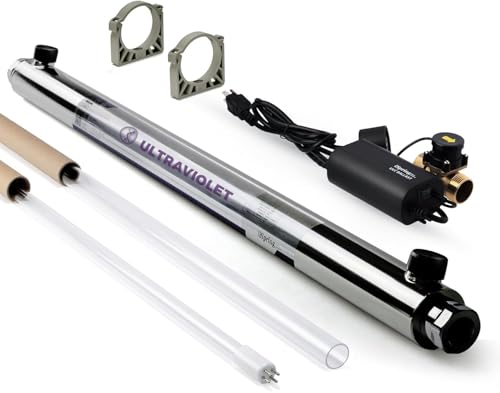
Bacteria is the only well-water problem on this page that is a health risk rather than an annoyance, and UV is the standard household answer to it. This unit runs 55 watts through a 37.5-inch stainless chamber at 12 GPM, with a flow sensor so the lamp only fires when water moves. Fit it last in the line, because UV works by light reaching organisms and cloudy water shields them. On the certification, see the section below: NSF/ANSI 55 exists, 362 products hold it, and this is not one of them.
What we liked
Treats the one well-water problem that is a health risk rather than a nuisance, and it does it without adding anything to the water
The flow sensor switch only runs the lamp when water moves, which is why the lamp lasts a year rather than burning continuously
12 GPM through a 37.5-inch stainless chamber, enough dwell time for a whole house rather than one tap
No chemicals, no byproducts and no taste change, which is the advantage over shock chlorination
Worth knowing
UV needs clear water to work, so it goes last in the line and only after sediment and iron have been taken out
The lamp is replaced annually and the quartz sleeve cleaned every 6 to 12 months, and a lamp still glowing can already be too weak to disinfect
iSpring holds no NSF/ANSI 55 listing for it, and that standard is the one that separates a UV unit rated to disinfect contaminated water from one rated only to polish water already known to be safe
UV is a certified category, and the class is the whole story
Whole-house filtration has no performance certification to look up, as
our whole-house page sets out.
Ultraviolet is the opposite: it has a real standard, NSF/ANSI
55, and a public database behind it. On 5 August 2026
that database held 362 products from 19 manufacturers.
And it splits them into two classes that sound similar and are not.
Class
Certified dose
Intended water
Inactivates
UV sensor
Products listed
Class A
40 mJ/cm²
Well and surface water, including water known or suspected to be contaminated
Bacteria, viruses, Cryptosporidium oocysts and Giardia cysts
Required, wired to an alarm
125
Class B
16 mJ/cm²
Supplemental treatment of water a health agency has already deemed acceptable
Non-pathogenic nuisance organisms
Not required
237
Class A is the well-water class. It is certified to deliver
two and a half times the dose, it is tested against Cryptosporidium and
Giardia rather than nuisance organisms, and it has to carry a sensor wired to
an alarm, because a UV lamp goes on glowing long after it has stopped
delivering a disinfecting dose. Class B assumes somebody has already declared
the water safe, which is precisely the assumption a private well does not let
you make.
237 of the 362 listed products are Class B. Roughly two in
three certified UV systems are certified for the case that is not yours, and
a retail listing that says "NSF 55" without naming the class has told you
nothing about which one you are looking at.
You can check any UV system in about a minute.
NSF's
standard 55 listing is public, it needs no account, and the claim column
prints "Disinfection Performance, Class A" or "Class B" against every model.
Search the manufacturer's model number rather than the retail title, the same
method written out here.
The UVF55FS above is not on that list, and iSpring holds no NSF/ANSI 55
listing at all, checked the same day against a database that does return
their reverse osmosis systems under standard 58. It is a 55-watt lamp in a
37.5-inch stainless chamber with a flow sensor, and what it is not is a unit
somebody else has measured. If your test came back positive for coliform and
you want the dose independently verified, the 125 Class A products in that
database are the shortlist, and the manufacturers holding them include
Aquasana, Culligan and Applied Membranes.
How to choose
Start with the test result, then buy in sequence. Almost
every well wants the spin-down, because it is the cheapest thing on this page
and it decides how often you touch everything else. Iron and manganese in the result means the
WGB32BM. Sulphur smell, scale or grit without staining means the WGB32B-KDS.
Coliform means UV as well, fitted after the filtration rather than instead of
it.
Do not buy for problems the test did not find. An iron stage
on iron-free water is a cartridge you replace annually for nothing, and the
same is true of a UV lamp on a well that has never grown anything. The
sequence above is the maximum, not the recommendation.
Size for flow, not for house size. These systems are rated
12 to 15 GPM, which suits most homes on a standard 1-inch service line. If
you have a large house running several bathrooms at once, or a long run of
old galvanised pipe already losing pressure, check the rating against your
peak draw before buying, because an undersized whole-house filter shows up
as a pressure complaint that no cartridge change fixes.
Common questions
What is the best water filtration system for well water?
There is no single one, because a well presents up to four separate problems and they are treated in order: sediment, then iron and manganese, then taste and chemistry, then bacteria. Start with a lab test, because it tells you which of those four you actually have. For a well that stains fixtures, a three-stage system with catalytic iron and manganese media is the core purchase. For a well that has tested positive for coliform, add ultraviolet disinfection as the final stage.
Do I need a water test before buying a well filter?
Yes, and it is the single highest-value thing on this page. A well has no utility behind it publishing an annual report, so the composition is unknown until somebody measures it. A state-certified lab test costs roughly $50 to $200 and tells you whether you need an iron stage, a sulphur stage, UV, or none of them. The EPA recommends testing a private well annually for coliform bacteria, nitrate, total dissolved solids and pH. Buying first and testing later is how people end up with a filter that treats a problem they do not have.
Does a whole house filter remove bacteria from well water?
No. Sediment, carbon and iron media are filtration, and they are not disinfection. Removing bacteria takes ultraviolet light, chlorination or a membrane fine enough to exclude them. If your well has tested positive for coliform, a cartridge filter is not the answer to that problem, and a UV unit fitted after the filtration is.
What is NSF/ANSI 55 Class A?
It is the ultraviolet certification class rated for water that may be contaminated, which is the case for a private well. A Class A system is certified to deliver 40 mJ/cm² and to inactivate bacteria, viruses, Cryptosporidium and Giardia, and it must carry a UV sensor wired to an alarm so it can tell you when the dose has fallen. Class B is certified to 16 mJ/cm², is intended as supplemental treatment of water already deemed acceptable by a health agency, and requires no sensor. Of the 362 UV products in NSF's database, 125 are Class A and 237 are Class B, so most certified UV systems are the class that is not intended for wells.
How much does a well water filtration system cost?
A spin-down pre-filter runs $50 to $90. A three-stage whole-house system with iron and manganese media runs $300 to $550, with cartridges at $100 to $200 a year. A whole-house UV unit runs $300 to $500, plus an annual lamp at roughly $50. A well needing all three is looking at $700 to $1,100 up front. Heavy iron above about 3 ppm, or hardness needing a softener, is a separate and larger job.
Related
Well water explained: what a test result means,
and what each contaminant costs to treat