We may earn a commission when you buy through links on this page, at no extra
cost to you. As an Amazon Associate I earn from qualifying purchases.
Your system's certificate names the cartridge it is certified with. NSF and IAPMO certify a reverse osmosis system in one configuration, and both publish the replacement component by model number: the iSpring RCC7AK is certified with FP15, FC15, FG15, MC7, FT15, FA15, and the Waterdrop X8-WAN with WD-X8-F3. Fitting those keeps the system in the state its claims were granted to. For a standard 5-stage system, the iSpring F7-GAC 7-count pack covers a year.
Change pre-filters every 6 to 12 months and the membrane every 2 to 3 years. The membrane is the part that removes dissolved contaminants, and it is the one most owners never replace: the standard 75 GPD membrane costs less per year than the cartridges around it.
Last updated
The certificate names your cartridge
Certification is granted to a system, in a configuration, and the
configuration is written down. NSF's listings carry a column headed
Replacement Module, with a note above the table stating
that all replacement modules are components. IAPMO's certificates carry a
column headed Replacement Component on every row. Both name
the cartridge by the manufacturer's model number.
That turns a vague question into a checkable one.
Can I use a cheaper filter? has no general answer. Is this
cartridge the one my system's certificate names? has exactly one, and
it is published, free, and takes two minutes to look up. A cartridge that
is not on the list will still fit, still filter, and still leave the
configuration the reduction claims were tested on.
The table below is that answer for the five systems on our
under-sink reverse osmosis
page. Every code was read from the certifier's own record on
5 August 2026: NSF's drinking water treatment unit listings
for the iSpring systems, and IAPMO certificates
WC-13976,
WC-14805 and WC-14301 for the Waterdrop ones.
Two details in that table are worth pulling out. The
Waterdrop X8 and the X8-WAN are certified with different carbon filters,
WD-F1G and WD-F1A, one letter apart. The
difference is remineralisation: Waterdrop sells the F1A as "alkaline mineral
added" and the F1G as "no minerals added", and IAPMO names the alkaline one
against the alkaline system. Get the letter wrong and the cartridge fits a
system it is not listed against. And the G3P800's seven contaminant claims
are all granted against WD-G3P800-RO, so that single cartridge
carries the entire reason to have bought that system.
The cartridge that is certified on its own
Everything in that table is a cartridge named by a certificate: the
system was tested with it fitted, so buying it keeps the system in the state
it was certified in. That is already more than anyone else prints. One
cartridge on this page goes further.
WQA lists the Brondell UF-15 in its own right, under three
standards, as an element and as a component. Not as a line inside a system's
certificate. Its own listing:
Standard
Listed as
Certified to reduce
NSF/ANSI 42
Replacement Element
Aesthetic chloramine and chlorine, nominal particulate class I, taste and odour
All sixteen claims the standard contains, microplastics among them
A single carbon block certified for PFOS and PFOA, lead, asbestos
and mercury, and for microplastics, is unusual enough to be worth
saying twice. It is the element inside the
Brondell Coral UC300 and
the Capella RC250, and it is where those systems get their claims from.
It is also the answer to a question this page raises and cannot otherwise
settle: when a cheaper cartridge says it fits, what are you giving
up? Usually there is no way to tell, because the generic has no
listing and the original is only named inside somebody else's certificate.
Here the original has a record of its own, so the comparison is a real one.
Which cartridge, by system
These are not ranked, because a ranking would answer a question nobody here
is asking. You already own a system. There is one right cartridge for it,
and the job of this page is to name it and show you the record that does.
The annual set for the system that leads our under-sink page. NSF lists the RCC7AK-BN with replacement modules FP15, FC15, FG15, MC7, FT15 and FA15, and this set carries the sediment, carbon and post-filter stages from that list. Its certification is not a separate reduction claim: NSF states that all replacement modules are components, so what these cartridges are certified as is parts of a certified system.
Fits
iSpring RCC7AK and RCC7AK-UV
Replace
Pre-filters every 6 months, post-filters every 12
Certifier calls it
FP15, FC15, FG15, FT15, FA15
What we liked
Contains every cartridge NSF names as a replacement module of the RCC7AK-BN, so a full change keeps the system in the configuration its certification was granted to
One box covers a year, which is the whole reason to buy a set rather than five cartridges on five different schedules
Includes the FA15 alkaline stage, the cartridge that separates the RCC7AK from the plain RCC7
Worth knowing
Does not include the membrane, which runs on a two to three year cycle and is bought separately
Costs about a third of what the system itself costs, which is the real running cost of reverse osmosis
Checked against NSF International , listed as RCC7AK-BN (modules FP15 FC15 FG15 MC7 FT15 FA15),
on .
A year of pre-filtration for the common 10 x 2.5 inch RO housing, the format most tanked systems use. NSF lists FP15, FC15 and FG15 among the replacement modules of iSpring's certified RCC7 systems. On another manufacturer's system a same-size cartridge will physically fit, and whether that keeps the system inside its certified configuration depends on what that system's own listing names.
Fits
Any standard 5-stage RO using 10 x 2.5 inch cartridges
Replace
Full change every 12 months
Certifier calls it
FP15, FC15, FG15
What we liked
The 10 x 2.5 inch format is an industry standard, so this fits most tanked RO systems rather than one manufacturer's
Cheapest route to a full year of pre-filtration on this page
Seven cartridges means the sediment stage can be changed more often than the carbon, which is the order they actually wear out in
Worth knowing
Pre-filters only: the membrane and the post-carbon stage are separate purchases
Fitting a standard-size cartridge into a certified system is only equivalent where the certifier names that cartridge, so check your system's module list first
Checked against NSF International , listed as RCC7-BN (modules FP15 FC15 FG15 MC7 FT15),
on .
The membrane is the only cartridge in a reverse osmosis system that removes dissolved solids, and it is the one most owners never replace. NSF lists MC7 as a replacement module of the certified RCC7 and RCC7AK systems. The 11.75 x 1.75 inch format is standard across tanked systems, and 75 GPD is the common rating.
Fits
Standard 11.75 x 1.75 inch membrane housing, 75 GPD
Replace
Every 2 to 3 years, or when TDS starts climbing
Certifier calls it
MC7
What we liked
This is the part that does the rejecting: every contaminant claim on a standard 58 certificate is earned here, not by the carbon around it
Runs two to three years, so it is the cheapest cartridge per year of anything on this page
A TDS meter tells you exactly when to change it, which no other cartridge offers
Worth knowing
Changing it means depressurising the system and flushing the new membrane before you drink from it
A membrane fails slowly rather than suddenly, so without a meter people run them years past useful
Checked against NSF International , listed as RCC7AK-BN (module MC7),
on .
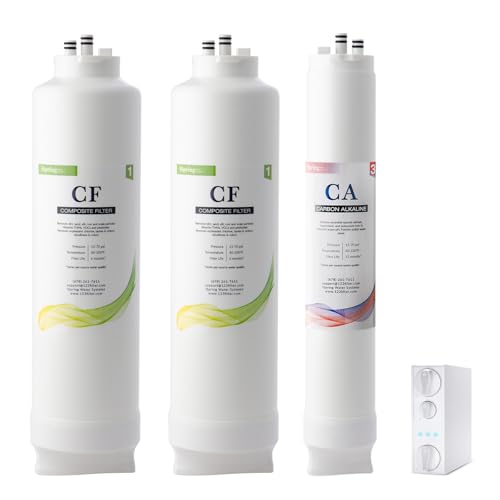
The annual pack for the RO500AK, the tankless system on our under-sink page. NSF lists that system as RO500AK-BN with replacement modules FCA500, FCF500 and MRO500, and this pack covers the first two. The membrane is bought on its own two-year cycle.
Fits
iSpring RO500AK tankless
Replace
Composite filters every 12 months, membrane every 2 years
Certifier calls it
FCA500, FCF500
What we liked
Carries FCA500 and FCF500, two of the three modules NSF names for the RO500AK-BN
Twist-out cartridges, so a change takes seconds and needs no tools or shut-off
The alkaline stage is built into the FCA500 rather than sold as a fourth cartridge
Worth knowing
The MRO500 membrane is the third module and is not in this pack
99 owner ratings is thin evidence next to the four-figure counts on the tanked cartridges
Checked against NSF International , listed as RO500AK-BN (modules FCA500 FCF500 MRO500),
on .
IAPMO certificate WC-13976 lists the Waterdrop X8-WAN with one replacement component against its standard 58 listing, and this is it. The X8-WAN is certified for dissolved solids under that standard, and this cartridge holds the membrane doing that work. Its two carbon stages, WD-F1A and WD-F2, are listed separately under standard 42.
Fits
Waterdrop X8 series, including the X8-WAN
Replace
Every 2 years
Certifier calls it
WD-X8-F3
What we liked
The exact component IAPMO names against WD-X8-WAN on certificate WC-13976, so the system stays in its certified configuration
Carries the RO membrane, which is the stage the standard 58 dissolved-solids claim is granted on
Two-year cycle, against six to twelve months for the carbon stages beside it
Worth knowing
The most expensive single cartridge on this page, and the X8-WAN needs the F1A and F2 as well
Sold through Amazon rather than the programme that pays us more, which is worth knowing about a page that earns commission
Checked against IAPMO R&T , certificate WC-13976, listed as WD-X8-F3,
on .
The G3P800 holds the widest certified claim list of any system on our under-sink page, and IAPMO grants all of it against one replacement component: WD-G3P800-RO. Fitting anything else leaves the configuration those claims were tested on. The carbon block WD-G3-CB, which carries the separate PFOA and PFOS claim under standard 53, is a second cartridge on a twelve-month cycle.
Fits
Waterdrop G3P800
Replace
Every 2 years
Certifier calls it
WD-G3P800-RO
What we liked
The component IAPMO names against WD-G3P800, whose standard 58 claims are the widest of any system we cover: fluoride, cadmium, hexavalent chromium, selenium, barium, radium 226/228 and dissolved solids
Every one of those seven claims is granted on this membrane, so it is the cartridge that carries the reason to own a G3P800
Two-year cycle, against twelve months for the carbon block beside it
Worth knowing
Does not cover the WD-G3-CB carbon block, which is the component carrying the separate PFOA and PFOS claim
Sold through Amazon rather than the programme that pays us more, which is worth knowing about a page that earns commission
Checked against IAPMO R&T , certificate WC-13976, listed as WD-G3P800-RO,
on .
Brondell UF-15 Single-Stage Carbon Block Water Filter
4.7 stars from 281 owner ratings
The cartridge that carries the certification rather than sitting inside one. Most replacement filters are named on a certificate as the component a certified system contains, which tells you the system was tested with it in place. WQA lists this one separately, under three standards, for PFOS and PFOA, lead, asbestos and mercury, and for all sixteen NSF/ANSI 401 claims including microplastics. It is the element inside the Coral UC300 and the Capella RC250, and it is the reason those systems hold what they hold.
Fits
Brondell H2O+ Coral UC300 and Capella RC250
Replace
Every 6 months
Certifier calls it
UF-15, listed by WQA as both a Replacement Element and a Component
Listed in its own right rather than only as a named component: WQA carries it under NSF/ANSI 42 as a Replacement Element, under 53, and under 401 as a Component holding all sixteen claims that standard contains.
Brondell RF-20 Sediment and Carbon Filter for Circle
4.6 stars from 1,771 owner ratings
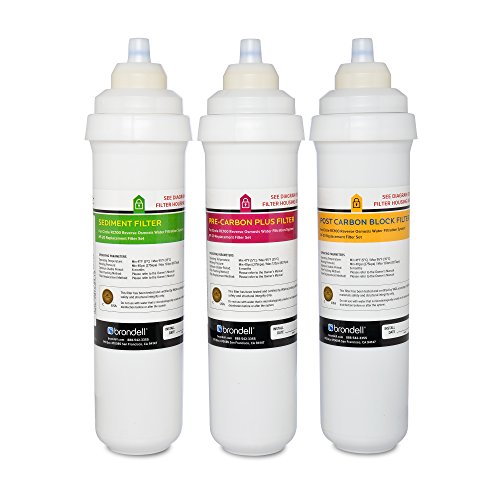
The three pre-filter stages of the Circle in one pack, and the ones that decide how long the membrane behind them lasts. Sediment and carbon do the protecting: chlorine destroys an RO membrane and grit blinds it, so a spent pre-filter does not merely stop working, it starts shortening the life of the most expensive part in the machine. Twist-in cartridges, so no tools and no housing wrench.
Fits
Brondell Circle RC100, all three pre-filter positions
Brondell RF-40 Reverse Osmosis Membrane for Circle
4.6 stars from 782 owner ratings
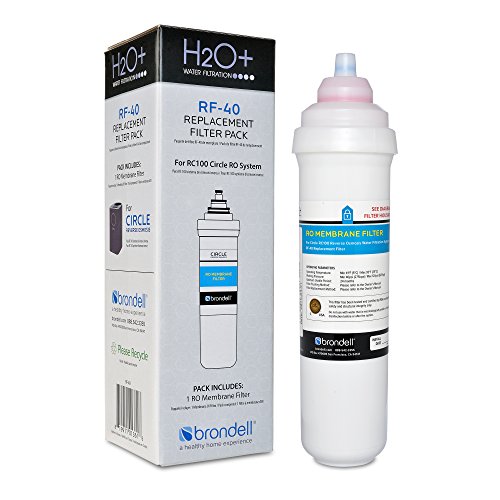
The part that does the work the Circle is certified for. Twelve of the contaminants on that certificate, lead and arsenic and fluoride among them, are removed by this membrane and by nothing else in the machine. It runs about two years against the pre-filters’ six months, and the only honest test is a TDS meter: replace it when reduction falls below roughly 75 per cent rather than when a light says so.
Manufacturers publish one interval for a whole system, which is convenient
and wrong: the stages wear at completely different rates, and the two that
matter most are the two on the longest and shortest cycles.
Stage
Interval
How you can tell
Sediment pre-filter
6 months
Goes visibly brown in a clear housing. On well water it can need changing at three months.
Carbon block pre-filter
6 to 12 months
Chlorine taste returning is the signal. This filter also protects the membrane, so running it long is expensive.
RO membrane
2 to 3 years
A TDS meter is the only honest test. Compare the tap against the filtered tap: when the reduction falls below about 75%, replace it.
Post-carbon polishing filter
12 months
Flat or stale taste from a system that is otherwise working.
Alkaline or remineralising filter
12 months
The media is consumed rather than clogged, so it stops working while still looking new. Replace by date.
Buy a TDS meter before you buy another membrane. They cost
about fifteen dollars and they turn the single most expensive cartridge in
the system from a guess into a measurement. Read the tap, then the filtered
tap. A healthy membrane removes somewhere north of 90% of dissolved solids;
when that falls to around 75%, it is done. Without a meter people replace
membranes that had another year in them, or drink from ones that stopped
working eighteen months ago.
Two of the certificates behind this page also state a capacity in gallons,
which is a better guide than a date for anyone on well water or a large
household. IAPMO rates the Waterdrop WD-F1A at
1,200 gallons, WD-F2 at
1,500 gallons, and WD-G3-CB at
1,100 gallons. A household drinking and cooking with four
litres a day takes nearly three years to put 1,100 gallons through a
cartridge, so on those systems the twelve-month interval is set by taste
rather than by exhaustion. Draw eight litres a day and the same cartridge is
spent in about seventeen months, which is the case the annual schedule is
written for.
Look yours up in four minutes
This works on any reverse osmosis system sold anywhere, including ones we
have never covered.
Find the manufacturer's model number, from the label on
the unit rather than the title you bought it under. Certifier databases
index by the maker's string: the system Amazon sells as "iSpring RCC7AK"
is filed by NSF as RCC7AK-BN.
Read across to the replacement column. NSF heads it
Replacement Module, IAPMO heads it Replacement Component. That is the
cartridge your certification is written against.
Match the code, not the marketing. A listing saying "fits
RCC7AK" is a compatibility claim by whoever wrote the listing. A code
appearing in the certifier's replacement column is the certifier's own
record.
Common questions
Can I use generic reverse osmosis replacement filters?
They will usually fit, because the 10 x 2.5 inch cartridge and the 11.75 x 1.75 inch membrane are industry-standard sizes. What changes is the certification. NSF and IAPMO certify a system in a defined configuration, and both print the replacement components by model number on the listing: NSF as the Replacement Module column, IAPMO as Replacement Component. Fitting a cartridge that is not on that list leaves the configuration the reduction claims were tested on. The system keeps working and the certificate no longer describes it.
How often should I change reverse osmosis filters?
Sediment and carbon pre-filters every 6 to 12 months, the post-carbon filter every 12 months, and the membrane every 2 to 3 years. Those are starting points rather than rules: hardness, sediment load and how much water you draw all move them. The membrane is the one to measure rather than schedule, using a TDS meter on the tap and on the filtered water.
Do I need to replace the RO membrane as often as the filters?
No, and this is the most common mistake. The membrane lasts two to three years while the cartridges around it last six to twelve months. It is also the part that does the actual work: every contaminant claim on a standard 58 certificate is granted on the membrane, not on the carbon. Changing pre-filters on schedule is what makes a membrane reach three years, because they exist to protect it.
What happens if I do not change RO filters?
The pre-filters clog first, which slows production and starves the membrane of the pressure it needs. Then chlorine reaches the membrane, which is what destroys it: thin-film composite membranes are damaged by chlorine, so an exhausted carbon block turns a cheap maintenance job into a costly one. The water does not become dangerous, it becomes untreated, and a TDS meter will show it.
How much do reverse osmosis replacement filters cost per year?
Between about $35 and $170 a year depending on the system. A standard tanked system using industry-size cartridges sits at the bottom of that range. Tankless systems use proprietary twist-in cartridges and sit at the top, which is a running cost worth adding to the purchase price when you are choosing between the two.
Refrigerator water filter replacement:
the same fitting is registered by the manufacturer in a version certified
for chlorine and taste and a version certified for lead and cysts
Best under-sink reverse osmosis systems:
the five systems whose cartridges are on this page, scored, with every
certification checked against the certifier's own database
Under-sink filtration: whether reverse osmosis
is the right answer in the first place