We may earn a commission when you buy through links on this page, at no extra
cost to you. As an Amazon Associate I earn from qualifying purchases.
For almost everyone it is the Sawyer Mini. A 0.1 micron hollow fibre membrane, two ounces, rated to 100,000 gallons, backflushable so it costs nothing to keep using, and more than 41,000 owner ratings behind it. Everything else here earns its price for a specific reason rather than by filtering better.
The three numbers that separate these are pore size, rated capacity and how the water gets through, and all three are published. Capacity is the one people skip: the Sawyer filters are rated to 100,000 gallons and the Waterdrop gravity bag to 1,400. For an emergency shelf that is still years of water. For weekly use it is the whole cost.
Last updated
What actually separates them
Every filter here strains water through a pore too small for the thing you
are worried about. None of them does chemistry. So the comparison is short,
and unusually honest, because the deciding numbers are ones manufacturers
print rather than ones anyone has to infer.
Filter
Pore
Rated capacity
How water gets through
Weight
Sawyer Mini
0.1 micron
100,000 gallons
Squeeze, straw, gravity or inline
2 oz
Sawyer Squeeze, Cnoc 2L
0.1 micron
100,000 gallons
Squeeze or hang as gravity
9.4 oz
Waterdrop Gravity Straw
0.1 micron
1,400 gallons
Gravity from a 1.5 gal bag, or straw
Bag, not pocket
Waterdrop TK15-A-S
Carbon block
6,000 gallons
Gravity, sits on a worktop
Not portable in the field sense
Three of the four share the same pore size, so on the thing
people ask about first they are equivalent. What differs is capacity, by a
factor of seventy, and how much effort it takes to get a litre out. Choose on
those.
Filter or purifier
The word on the box matters and the difference is a real one.
A filter strains: at 0.1 micron it removes bacteria and protozoa,
which are bigger than the pore. Viruses are smaller than that, so a
filter is not the tool for them.
In North America, Europe and most places people walk, the realistic risk is
protozoa such as Giardia and Cryptosporidium, and a hollow fibre filter is
the right answer. A purifier adds chemical treatment or ultraviolet
light to cover viruses as well, and is what you want for travel
somewhere that genuinely has a waterborne virus risk. That is the whole
distinction, and it is why "filter" and "purifier" are not marketing
synonyms.
On certification here
The certifications this site checks elsewhere, NSF/ANSI
42, 53 and 58, are written for treating a domestic supply. Camping
filters are built and tested against microbiological removal protocols
instead, so the specification to compare is pore size and rated capacity, and
both are published for every product here.
Where a product does name a standard, read which one. The
Waterdrop worktop system names NSF/ANSI 42 and 372: 42 covers chlorine,
taste, odour and particulates, and 372 certifies that the materials do not
add lead to the water. Both are real and useful in a kitchen. Neither is the
microbiological claim a camping filter rests on, and a reader who saw only
"NSF certified" would reasonably assume otherwise.
The filters
No scores on this page, deliberately. Our formula weighs owner ratings,
certification, cartridge count and warranty, and three of those four say
nothing here: a hollow fibre filter is one cartridge by definition, the
category carries no drinking water certification, and "rated to 100,000
gallons" is a capacity claim rather than a warranty. That would leave a
number out of 100 resting on owner ratings alone, which would look like a
measurement and be a rating in a hat. The table above is the comparison.
★ The default
Sawyer SP128 Mini Water Filtration System
Almost everyone, and the one to buy first if you are buying one
Sawyer
★★★★½4.741,269 ratings
The filter that defined this category and still the one to beat. A hollow fibre membrane rated at 0.1 micron absolute, weighing two ounces, rated to 100,000 gallons and backflushable, so after the purchase it costs nothing to keep using. It has more owner ratings than everything else on this page combined by a wide margin. What it does not do is chemistry: anything dissolved rather than suspended goes through it untouched.
Brand
Sawyer
Stages
1-stage
Capacity
100,000 gal
Flow rate
Squeeze, gravity, straw or inline on a hydration pack
Warranty
Rated to 100,000 gallons by the manufacturer
Size
5 x 1 inches
CertificationThird-party tested, per manufacturer
Checked against Manufacturer
listed as SP128 ·
checked 2026-08-06 Sawyer states every unit is individually tested three times before it ships
What we liked
0.1 micron absolute hollow fibre, the finest pore commonly sold and small enough to strain out bacteria
Over 41,000 owner ratings, more field evidence than anything else in this category by an order of magnitude
Rated to 100,000 gallons and backflushable, so the running cost after purchase is close to nothing
Two ounces and no power, which is why it works in a power cut as well as on a trail
Fits a squeeze pouch, a standard bottle thread, a hydration pack or your mouth, so one filter covers every method
Worth knowing
Removes what it can strain and nothing it cannot, so dissolved lead, fluoride and PFAS pass straight through
Squeezing a pouch is fine for a hike and tedious as the way a household drinks
The pouch is the weak point, not the filter, and is the part people replace
Anyone who has owned a squeeze filter and got tired of the bag
Sawyer
★★★★★4.9247 ratings
The same membrane as the Mini attached to a far better bag, and on a squeeze filter the bag is what you actually interact with. The Cnoc bladder holds two litres, opens wide enough to scoop from a shallow stream, and hangs as a gravity feed so it fills a pot unattended. It costs more than twice what the Mini does and buys no extra filtration, which is the honest way to describe it: this is a convenience upgrade, and it is a real one.
Brand
Sawyer
Stages
1-stage
Capacity
100,000 gal
Flow rate
Squeeze or hang as gravity, 2 litre bladder
Warranty
Lifetime
Size
11.75 x 5.5 inches
CertificationThird-party tested, per manufacturer
Checked against Manufacturer
listed as SP302 series ·
checked 2026-08-06 Sawyer states the filter is reusable and cleanable, warrantied for the life of the filter
What we liked
The same 0.1 micron filter as the Mini with a much better bag, which is the part that actually decides how pleasant this is
A 2 litre wide-mouth TPU bladder fills from a shallow stream where a narrow pouch will not
Hangs as a gravity system, so it fills a pot while you set up camp instead of being squeezed
4.9 stars, the highest rating on this page
Lifetime warranty on the filter itself
Worth knowing
More than twice the price of the Mini for the same filtration
9.4 ounces against 2, which matters if you count grams
Groups, base camp, and a bag on the emergency shelf
Waterdrop
★★★★½4.63,673 ratings
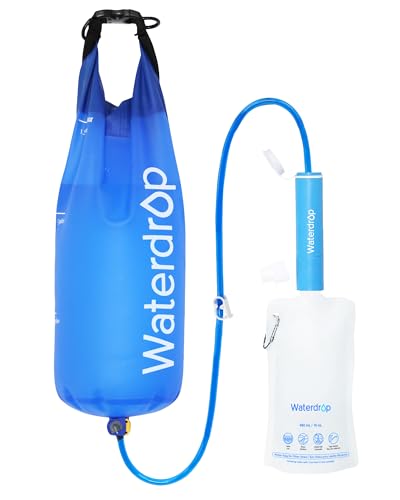
The one that treats water for several people at once. A 1.5 gallon bag fills, hangs and drains through a 0.1 micron filter without anyone squeezing anything, which is the right shape for a camp or a household without power. The number to weigh against the Sawyer is capacity: 1,400 gallons against 100,000. For occasional and emergency use that is years of water. For a filter you use every week it is not.
Brand
Waterdrop
Stages
1-stage
Capacity
1,400 gal
Flow rate
Gravity from a 1.5 gallon bag, or as a straw
Warranty
30 day limited filter warranty
Size
10.9 x 6.8 inches
CertificationNone stated
What we liked
A 1.5 gallon bag, so it treats water for a group rather than a person
0.1 micron, the same pore class as the Sawyer filters
3,610 ratings, second only to the Sawyer Mini in this category
Works as gravity or as a straw, which covers both the camp and the emergency case
Worth knowing
Rated to 1,400 gallons against the Sawyer’s 100,000, so the long-run cost is completely different
A 30 day warranty, which is the shortest on this page by a long way
A large bag is the point and also the reason it does not fit in a jacket pocket
A house with no filtered water and no appetite for plumbing, or an outage that lasts days
Waterdrop
★★★★½4.3137 ratings
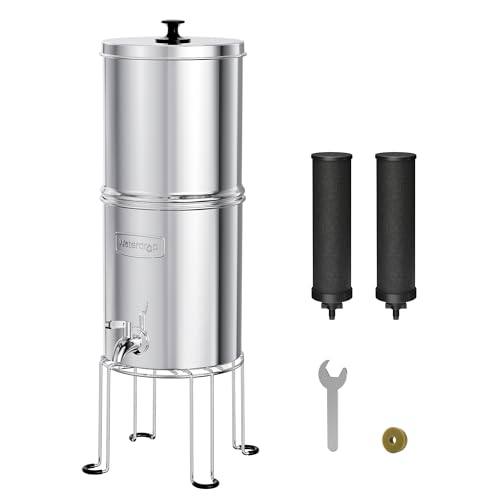
The one that is portable in the sense that you can carry it into a kitchen, not up a mountain. Two stainless chambers, gravity fed, 6,000 gallons of capacity and no installation of any kind. It is the only product here whose maker names a standard, and it is worth knowing which: NSF/ANSI 42 is aesthetic effects, so chlorine, taste, odour and particulates, and 372 is a materials standard certifying the housing does not add lead. Both are real and neither is the microbiological claim the camping filters rest on.
Brand
Waterdrop
Stages
2-stage
Capacity
6,000 gal
Flow rate
Gravity, 1.5 gallon capacity, no plumbing or power
CertificationThird-party tested, per manufacturer
Checked against Manufacturer
listed as TK15-A-S ·
checked 2026-08-06 Waterdrop states certification against NSF/ANSI 42 and 372. Standard 42 covers aesthetic effects, which is chlorine, taste, odour and particulates; 372 certifies that the materials do not add lead. Waterdrop appears in NSF's database under 591 other listings and certifies elsewhere with IAPMO, whose listings NSF does not carry, so this is the manufacturer's statement rather than a record we have read.
What we liked
Two stainless steel chambers rated to 6,000 gallons, which is four times the gravity bag and lasts a household years
The only product here whose maker names a standard, and standard 42 is the chlorine, taste and odour one
Sits on a worktop and needs no plumbing, no power and no fitting
A 1.5 gallon reservoir refills without anyone holding anything
Worth knowing
Ten times the price of the Sawyer Mini and it does not go anywhere
Only 137 ratings, the thinnest evidence on this page
Standard 42 is the aesthetic standard, so the named certification covers taste and chlorine rather than the microbiological job a camping filter is bought for
For almost everyone it is the Sawyer Mini, and the reason is not subtle: a 0.1 micron hollow fibre membrane, two ounces, rated to 100,000 gallons, backflushable so it costs nothing to keep using, and over 41,000 owner ratings behind it. The alternatives are worth their money for specific reasons rather than better filtration. A bigger bag is more pleasant to fill, a gravity system treats water for a group, and a worktop unit is for a house rather than a trail.
Do portable water filters remove viruses?
A 0.1 micron filter is sized to remove bacteria and protozoa, which are larger than the pore, and viruses are smaller than that. In North America, Europe and most of the places people hike, protozoa such as Giardia and Cryptosporidium are the realistic risk and a hollow fibre filter addresses them. If you are travelling somewhere with a genuine waterborne virus risk, the tool for that is a purifier, meaning a filter combined with chemical treatment or ultraviolet light, and the distinction between a filter and a purifier is exactly this one.
Are portable water filters certified?
Not in the sense used for home filters, and that is a fact about the category rather than a criticism of any product. NSF/ANSI 42, 53 and 58 are written for treating a domestic supply, and camping filters are built and tested against microbiological removal protocols instead. So the specifications that matter here are pore size and rated capacity, both of which manufacturers publish and both of which are directly comparable. Where a product does name a standard, read which one: NSF/ANSI 42 covers chlorine, taste and odour, and 372 certifies that the materials do not add lead.
Can I use a camping filter at home in an emergency?
Yes, and it is one of the better reasons to own one. A hollow fibre filter needs no power, no plumbing and no chemicals, which is exactly the situation a boil-water notice or an outage creates. A squeeze filter will do it for one person. For a household, a gravity bag or a worktop gravity system is far less tedious, because nobody wants to squeeze a pouch for four people three times a day.
How long does a portable water filter last?
The spread is enormous and it is the number people skip. Sawyer rates the Mini and the Squeeze to 100,000 gallons and both are backflushable, so with cleaning they effectively last as long as you look after them. The Waterdrop gravity straw is rated to 1,400 gallons and the worktop system to 6,000. For occasional or emergency use any of those is years of water. For weekly use the difference is what decides the real cost.