We may earn a commission when you buy through links on this page, at no extra
cost to you. As an Amazon Associate I earn from qualifying purchases.
The best whole house water filter for most homes is the iSpring WGB32B, a three-stage system that removes sediment, chlorine and taste at the main line, rated 100,000 gallons at 15 GPM, which covers a typical household for about a year.
On a private well, buy the WGB32BM instead: it swaps the third stage for iron and manganese media, which is the problem city-water filters ignore and the reason well water stains fixtures. See well water systems for the full treatment order. To spend less, the WGB22B keeps the same housings, ports and cartridge life for less.
Last updated
We scored every system on four things we can verify: owner ratings weighted
by how many people left them, the number of filter cartridges the water
passes through, NSF/ANSI certification, and warranty length. The formula is
published on how we rate.
One thing worth knowing before the list: we have not found a whole
house system carrying an NSF/ANSI performance certification. Not
one of the 69 in
our latest survey, not one
of the 21 in the earlier one, and not one of the 85 whole-house systems we
can currently see across the brands we work with. On 4 August 2026 we searched NSF's own database for iSpring,
the brand on this page: it returns their reverse osmosis systems and
no whole house model at all, and searches under NSF/ANSI
42 and 53 return no matching products.
You
can run that search yourself; the
method is written out here
and takes about a minute.
That absence is genuinely useful information, because it saves you hunting
for a badge that is not there, and it means anything that looks
like one deserves a second read. Fifteen of those 85 systems advertise
"SGS-tested" media. SGS is a testing laboratory, not an accredited
certification body, so that language sits in our
"tested" tier rather than the certified one, and
at least one major retailer prints it in a spec field labelled
"Certifications". Certification is a real differentiator on under-sink
systems and pitchers. At whole-house scale it is simply not on offer, so
these systems are judged on owner evidence, capacity, flow rate and warranty
instead.
Our picks
These answer different questions rather than competing for one spot. The
well-water system is not a runner-up: if your water leaves rust marks, it is
the one to buy, and the fact that it scores a little lower than the
city-water pick is irrelevant to you. Read the label on each card first,
then the score, which says how good that system is rather than what position
it came in.
★ Best for lead
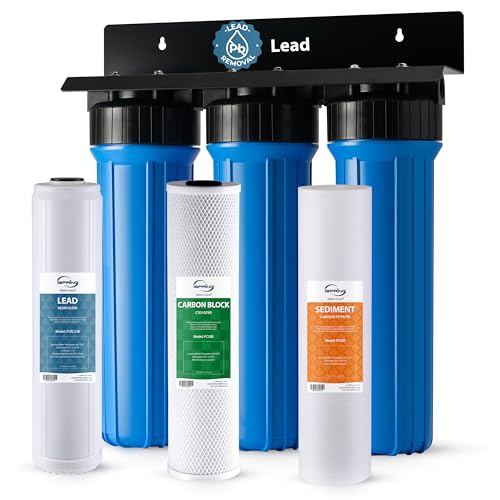
iSpring WGB32B-PB Lead-Reducing Whole House Water Filter System
Older homes, or anywhere a water test has shown lead
The same three-stage platform with the second stage swapped for lead-reduction media. Worth the premium only if a water test has actually shown lead, which usually means a house with pre-1986 plumbing or a supply line you cannot account for. On a clean municipal supply you are paying for capacity you will never draw on.
Brand
iSpring
Stages
3-stage
Capacity
100,000 gal
Flow rate
15 GPM
Warranty
1 year
Size
24.25 x 7.75 x 27.75 inches
CertificationThird-party tested, per manufacturer
What we liked
Adds a dedicated lead-reduction stage over the standard WGB32B
Amazon listing states both filters are third-party tested to meet NSF/ANSI standards
Same 100,000-gallon capacity and flow rate as the standard model
Worth knowing
Costs more than the standard WGB32B for the extra stage
The default whole house system for city water, and the one most homes should start with. Three stages take out sediment, then chlorine, then the taste that comes with it, at a flow rate high enough that a household of four will not notice the filter is there. It does not soften water and does not touch fluoride. For hard water or fluoride you are adding a second piece of kit, not swapping this one.
Brand
iSpring
Stages
3-stage
Capacity
100,000 gal
Flow rate
15 GPM
Warranty
1 year
Size
24.25 x 7.75 x 27.75 inches
CertificationThird-party tested, per manufacturer
What we liked
Three stages handle sediment, chlorine and taste in one unit
100,000-gallon capacity, roughly a year for most households
15 GPM flow rate keeps pressure normal across several bathrooms
Standard 20-inch cartridges, so replacements are easy to source and cheap to compare
Worth knowing
Cartridges need replacing yearly and are not the cheapest
Does not soften water, so hard-water homes need a separate softener
Built for wells rather than mains water, which is a different problem entirely. Iron and manganese are what stain fixtures orange and put a metallic edge on the taste, and a standard carbon system ignores both. If your water leaves rust marks in the sink, this is the version of the WGB32B to buy. If it does not, it is the wrong one.
Brand
iSpring
Stages
3-stage
Capacity
100,000 gal
Flow rate
15 GPM
Warranty
1 year
Size
24.25 x 7.75 x 27.75 inches
CertificationThird-party tested, per manufacturer
What we liked
Targets iron and manganese, the two problems city-water filters ignore
Stops the rust staining that ruins fixtures and laundry on well supplies
Same three-stage housing as the rest of the WGB32B range
Catalytic media is not consumed as it works, so it outlasts greensand alternatives
Rated 100,000 gallons, about a year for a household of four
Worth knowing
Pointless on municipal water, where you pay for capability you will never use
Heavy iron loads may still need a dedicated air-injection system
The cheapest way onto this page, and the one where the running cost deserves a second look before you buy. It genuinely runs three cartridges with a double carbon pass, which nothing else here at this price does. But the 2.5-inch cartridges hold roughly a third of the media of the 4.5-inch ones, so they are rated 30,000 gallons rather than 100,000 and want changing about twice as often. Over five years that usually costs more than the money saved at the till. One detail worth flagging: the Amazon specification table lists 15 GPM, while iSpring’s own manual, Home Depot and Lowe’s all say 12. We have used 12.
Brand
iSpring
Stages
3-stage
Capacity
30,000 gal
Flow rate
12 GPM
Warranty
1 year
Size
17.5 x 6.5 x 24.75 inches
CertificationThird-party tested, per manufacturer
What we liked
Three separate cartridges, including two carbon passes, at the lowest price on this page
Slim 2.5-inch housings fit utility spaces a Big Blue system will not
Red pressure-release buttons and an included wrench make cartridge changes genuinely easy
Red pressure-release buttons on each cap make cartridge changes genuinely quick
Worth knowing
Cartridges are rated 30,000 gallons against 100,000 on the wider systems, making it cheapest to buy and dearest to run
The 3/4-inch moulded plastic threads are the weak point and leak readily; 12 GPM can bottleneck a larger house
The WGB32B with one of its two carbon stages removed, and for most city-water homes that is a fair trade. It keeps everything that governs whether you notice the filter is there: the 20-inch housings, the 1-inch ports, the 15 GPM peak flow and the 100,000-gallon cartridge life. It gives up only the second polishing pass. Buy the three-stage version if you want the belt and braces; buy this one if you want the same water for less.
Brand
iSpring
Stages
2-stage
Capacity
100,000 gal
Flow rate
15 GPM
Warranty
1 year
Size
16.25 x 7.75 x 27.75 inches
CertificationThird-party tested, per manufacturer
What we liked
The flagship platform minus one carbon pass, keeping the 20-inch housings, 1-inch ports and 15 GPM
100,000-gallon cartridges, about a year for a household of four
Chlorine taste and smell go within hours, and owners consistently report no pressure change
US-based support that ships replacement heads and O-rings free, often years past the warranty
Worth knowing
Leaks at the threaded fittings on first pressurisation are the recurring complaint, so budget extra PTFE tape
No iron or lead media, so a well or a dirty supply needs a spin-down filter ahead of it
Running one costs about the price of the cartridges each year, and the
stages do not wear at the same rate. Which cartridge belongs in which
position, and how often each needs changing, is on
whole house replacement filters.
How to choose
Start with a water test, not a product. A whole house filter
is chosen against a specific problem, and buying before you know the problem
is how people end up with a system that does nothing for them. Municipal
supplies publish an annual water quality report; private wells need a lab test.
City water generally needs sediment and carbon stages, which
handle chlorine, chloramine and the taste that comes with them.
Well water is a different job: iron, manganese, sulphur and
bacteria are the usual culprits, and none of them are addressed by a standard
carbon filter. If the difference between those stages is not obvious,
how water filters work covers
what each mechanism removes and what it misses.
Match flow rate to your house. A system rated below your peak
demand will drop pressure noticeably. As a rough guide, 1–3 bathrooms wants
around 9 GPM, 4 or more wants 12 GPM or better. Most systems here run 1-inch
ports at 15 GPM; the WCB32O runs 3/4-inch ports at 12, which is fine for a
smaller house and tight for a larger one.
Then work out the running cost, because it is where these systems
actually differ. Cartridge diameter decides it. A 4.5-inch "Big
Blue" cartridge holds roughly three times the media of a 2.5-inch one, and
is rated accordingly, at 100,000 gallons against 30,000. That is the whole
reason the cheapest system on this page is also the most expensive to own:
it wants new cartridges about twice as often, and over five years that
usually overtakes the money saved at the till. If you are choosing between
two systems on price, compare cost per year rather than the sticker.
Common questions
What are the disadvantages of a whole house water filter?
Three main ones. Cartridges need replacing every 6–12 months at ongoing cost. Undersized systems can drop water pressure across the house. And a standard carbon filter does not soften water, so hard-water problems like limescale need a separate softener.
How much should a whole house water filtration system cost?
Cartridge-based three-stage systems typically run $300–600 with replacement cartridges at $80–150 a year. Tank-based systems start around $1,000 but last up to ten years on the main media, which usually works out cheaper per year.
What kind of whole house water filter should I buy?
It depends on your water source. City water needs sediment and carbon stages for chlorine and chloramine. Private well water needs sediment plus iron and manganese removal, and often UV disinfection. Test your water before buying, because the right system follows from the result.