We may earn a commission when you buy through links on this page, at no extra
cost to you. As an Amazon Associate I earn from qualifying purchases.
One filter here has been certified for microplastics rather than argued into it. The Brondell Coral UC300 holds all sixteen claims under NSF/ANSI 401, microplastics among them, plus lead and PFAS under NSF/ANSI 53. If your water also has fluoride or high dissolved solids, which no carbon filter touches, the iSpring RCC7AK puts a reverse osmosis membrane in the way instead. Without touching the plumbing, the Waterdrop ED01B runs a 0.5 micron carbon block.
There is a certification for this, and one filter here holds it. Microplastics Reduction is one of sixteen separate claims under NSF/ANSI 401, each granted on its own test, and 1,099 models hold it. The Brondell Coral UC300 holds all sixteen of them, and is separately certified for lead and PFAS. So the standard number on a box names the rulebook, and the claim list underneath it names what was measured.
Last updated
What the certification actually says
Almost every filter sold now says something about microplastics, and until
you look it is hard to tell which of those sentences rests on a test. It
turns out a good many can, because microplastics reduction is a
certifiable claim: NSF lists it under NSF/ANSI 401, and querying
their database for it returns 1,099
certified models.
The structure underneath is the useful part. NSF/ANSI 401 is the emerging
contaminants standard and it contains 16 separate
claims, covering pharmaceuticals such as ibuprofen and naproxen,
hormones such as estrone, industrial chemicals such as bisphenol A, and
microplastics. Each is granted on its own test. A
manufacturer submits a product for the claims it wants and is listed for
those, so two filters can both be certified to NSF/ANSI 401 and have been
measured for entirely different things.
That makes the standard number on a box the wrong thing to compare, and it
is usually the only thing printed. The claim list is public for
every certified product, in the certifier's own database, searchable
by the manufacturer's model number. It is the sentence after the standard
number that answers the question you came with, and reading it takes about a
minute.
Pore size is the mechanism
A plastic fragment is a suspended particle. It is not dissolved and it does
not react, so it is removed by one thing only: being too big to get through.
That makes this an unusually honest category, because the number that decides
the outcome is a number manufacturers publish.
What
Size
Why it matters
A human hair, for scale
70 microns
Visible. Nothing on this page struggles with it.
Microplastics as drinking water studies measure them
Down to about 1 micron
Below roughly a micron, the standard analytical methods stop counting reliably, so this is the floor of what is measured rather than the floor of what exists.
Waterdrop ED01B carbon block
0.5 microns
Half the size of the smallest fragment routinely counted.
Sawyer Mini hollow fibre
0.1 microns absolute
Fine enough to strain out bacteria, which are larger than the pore.
A reverse osmosis membrane
About 0.0001 microns
Rejects dissolved salt ions. A plastic fragment is thousands of times larger.
Every filter on this page sits below the size at which drinking water studies
can reliably count a fragment. That is the reason the choice here is
not really about microplastics. It is about what else is in your
water: lead, fluoride, PFAS and dissolved solids all pass straight through
any pore wide enough to let water through at a useful rate, and only the
membrane systems address them. Pick on that, and the plastic is handled
either way.
The one that is certified for it
Everything else on this page is chosen on pore size, which is sound physics
and is how nearly every "removes microplastics" claim is arrived at. One
product here has instead been tested by a certifying body and written into a
public record, and it is worth separating for that reason.
The Brondell Coral UC300 holds all sixteen claims under NSF/ANSI
401, microplastics among them, and is separately certified under
NSF/ANSI 53 for lead, PFOS and PFOA. That combination on one
listing is rare. It is verifiable by model number in
WQA's
Gold Seal database, which also names the UF-15 as the cartridge that
configuration was certified with.
It is a carbon filter, so fluoride and dissolved solids still need a
membrane. For anything a laboratory has actually tested it against, nothing
else here is close.
The filters
★ Best overall
iSpring RCC7AK 6-Stage Reverse Osmosis System
Anyone who wants the strongest physical barrier on the page, plumbed in and permanent
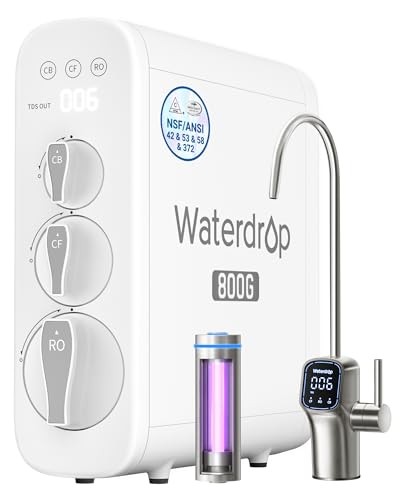
The system to buy unless you have a specific reason not to. What separates it is not the six stages or the price but the certification: NSF lists it as certified under standard 58 for lead, fluoride, asbestos, barium, cadmium, chromium, copper and selenium, where most of its rivals are certified for dissolved solids alone. It is old-fashioned: a tank, a slow refill, a lot of water down the drain. It has also been checked against more of the things people are actually frightened of than anything else on this page.
The strongest certification on this site, and the reason is what it covers rather than how many badges it carries. Under NSF/ANSI 53 it is certified for lead, PFOS and PFOA. Under NSF/ANSI 401 it holds all sixteen claims that standard contains, microplastics included. Most products certified to 401 hold a few of those claims, because each is granted on its own test. This is a carbon filter, so fluoride and dissolved solids still need a membrane, but for contaminants somebody has actually tested for it is unmatched at the price.
The other fifteen emerging contaminants in standard 401
Checked against Water Quality Association listings
listed as Brondell H2O+ Coral, UC300 Three-Stage Under Counter Water Filtration System ·
checked 2026-08-06 WQA Gold Seal under NSF/ANSI 42, 53, 401 and CSA B483.1. The 401 listing carries all sixteen claims that standard contains, microplastics among them. WQA lists UF-15 as the certified replacement Component.
What we liked
Certified for microplastics, lead and PFAS on one listing, which is a combination nothing else on this site holds
Holds all sixteen claims NSF/ANSI 401 contains, where a product certified to 401 usually holds a handful
Certified under three NSF/ANSI standards plus the Canadian CSA B483.1, all four verifiable by model number in WQA’s database
1,236 owner ratings at 4.6, the best rating on any certified product we carry
Costs less than half what the reverse osmosis systems here cost, and wastes no water
Worth knowing
Carbon filtration, so fluoride and total dissolved solids pass through, and only a membrane addresses those
Needs plumbing into the cold supply and a hole for its own tap, so it is not a rental solution
Cartridges are proprietary, and the certified configuration is the one using the UF-15
The most thoroughly certified system on this page, and the claim lists are why rather than the count. IAPMO certificate WC-13976 lists it under NSF/ANSI 58 for fluoride, cadmium, hexavalent chromium, selenium, barium, radium 226/228 and dissolved solids. A second certificate, WC-14805, adds NSF/ANSI 53 for PFOA and PFOS. That is the widest verified coverage here, spread across four certificates, and the price is the cost of all that paperwork being real. The UV stage is a genuine addition rather than a sticker.
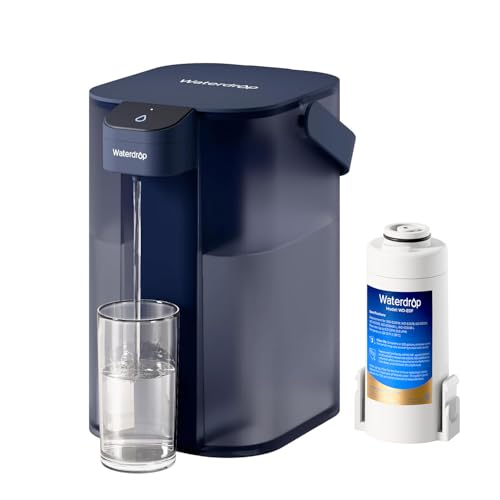
The cheapest thing on this page that is doing serious work. The pore size is the reason: at 0.5 micron this carbon block is an order of magnitude finer than the cartridge in a supermarket jug, and particle size is the mechanism that decides whether a plastic fragment gets through. It carries four certifications, which is more than most plumbed systems, and it fits in a fridge door.
The last one is not a kitchen filter and is not scored as one. It has no
stage count and no warranty in the sense the formula means, so half of that
formula would be measuring nothing, and a score built from half a formula
still reads as authoritative. It is here because it has the finest pore size
on the page and needs no power, plumbing or fitting.
★ Finest pore size here
Sawyer SP128 Mini Water Filtration System
Travel, camping and the emergency shelf, not the kitchen tap
Sawyer
★★★★½4.741,269 ratings
A hollow fibre membrane rated at 0.1 micron absolute, which is the finest barrier on this page and the reason it is here. Sawyer states every unit is individually tested three times before it ships. What it does not do is chemistry: anything dissolved rather than suspended goes through it untouched, so it belongs alongside a home system rather than instead of one.
Brand
Sawyer
Stages
1-stage
Capacity
100,000 gal
Flow rate
Squeeze, gravity or straw
Warranty
Rated to 100,000 gallons by the manufacturer
Size
5 x 1 inches
CertificationThird-party tested, per manufacturer
Checked against Manufacturer
listed as SP128 ·
checked 2026-08-05 Every unit individually tested three times to Sawyer performance standards
What we liked
0.1 micron absolute hollow fibre, the finest pore size on this page by a factor of five
Over 41,000 owner ratings, more field evidence than every other product here combined
Rated to 100,000 gallons and backflushable, so the running cost is close to nothing
Two ounces and no power, which is why it is the one that works in a power cut
Worth knowing
Removes what it can strain and nothing it cannot, so dissolved lead, fluoride and PFAS pass straight through
Squeezing a pouch is fine for a hike and tedious as the way a household drinks
Is there an actual certification for microplastics removal?
Yes. Microplastics Reduction is one of the sixteen claims under NSF/ANSI 401, and NSF's public database returns 1,099 certified models for it. The part worth knowing is that the sixteen claims in 401 are granted separately, one test at a time, so a filter certified to NSF/ANSI 401 has been tested under that standard for whichever claims it was submitted for. The standard number on a box tells you which rulebook was used; the claim list tells you what was measured. Both are published, and the claim list is the one that answers the question.
What size are microplastics, and does pore size decide it?
Pore size is the mechanism, yes, because a plastic fragment is a suspended particle rather than something dissolved, so it is removed by being too big to pass. Drinking water studies count particles down to roughly one micron, which is where the standard analytical methods stop being reliable. A 0.5 micron carbon block, a 0.1 micron hollow fibre membrane and a reverse osmosis membrane at about 0.0001 microns are all below that, by one, ten and ten thousand times respectively.
Does a Brita or a standard jug filter remove microplastics?
An ordinary jug cartridge is granular activated carbon built for chlorine, taste and odour, and its pore structure is far coarser than the filters on this page. If you want a jug rather than a plumbed system, the thing to compare is the pore size in microns and the certified claim list, both of which manufacturers publish. That is the difference between the electric pitcher here at 0.5 microns and a supermarket cartridge that does not state a figure at all.
Does boiling water remove microplastics?
No. Boiling kills organisms and does nothing to a plastic fragment, which is not alive and does not evaporate. There is research suggesting that boiling hard water can trap some nanoplastics in the limescale that forms, which then has to be filtered out, but that is a laboratory result about hard water rather than a method to rely on. Removal is physical: something has to strain the particle out.
Do I need reverse osmosis, or is a filter enough?
For microplastics alone, a fine enough filter is enough, because the particle is suspended and straining it out works. Reverse osmosis earns its cost on the things a strainer cannot touch: lead, fluoride, PFAS and dissolved solids all pass through any pore large enough to let water through at a useful rate. So the honest way to choose is by what else is in your water. If the answer is only plastic, the pitcher does it. If the answer includes anything dissolved, the membrane is the reason to plumb one in.