We may earn a commission when you buy through links on this page, at no extra
cost to you. As an Amazon Associate I earn from qualifying purchases.
The best under-sink reverse osmosis system for most homes is the iSpring RCC7AK, because it is certified under NSF/ANSI 58 for lead, fluoride, asbestos, barium, cadmium, chromium, copper and selenium, while most systems carrying the same badge are certified for dissolved solids alone.
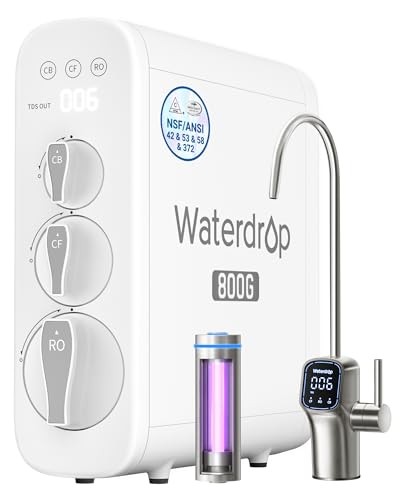
If cabinet space or waiting on a tank is the problem, the Waterdrop X8-WAN is the tankless system to buy: twice as fast, half the water wasted, and certified under the same standard, for dissolved solids only. For PFAS specifically, the Waterdrop G3P800 is the only one here whose record names PFOA and PFOS.
Last updated
Every system here was scored on the same four inputs we use everywhere:
owner ratings weighted by volume, certification, filter stages and warranty,
each measured against what is achievable in this category. The formula is
published on how we rate.
What we found checking the certificates
Under-sink is the one category where certification genuinely separates
products: a quarter of them
name a standard you can look up, against none at whole-house scale. So we did not
take the badge at face value. On 4 August 2026 we looked up
every system on this page in the certifier's own public database, by the
manufacturer's model number, and read the claim list attached to each
record. Every card states which database, which model string and which
certificate, and links to it. The method is
written out below so you can repeat it on any filter
you are considering, including ones we have never covered.
The badge is not the claim. "NSF/ANSI 58 certified" is not
a single statement. Standard 58 certifies a system for the specific
contaminants it was tested against, and that list is where the products
diverge. Under standard 58 the Brondell Circle is listed for twelve named
contaminants, including lead, arsenic, fluoride, hexavalent chromium, radium
226/228 and cyst. The iSpring RCC7AK is listed for eight, including lead and
fluoride. The Waterdrop G3P800 is listed for six. The Waterdrop X8-WAN and
the iSpring RO500AK are listed for dissolved solids alone. All five say
"NSF/ANSI 58 certified", and all five are telling the truth.
A second certificate can widen it further. The G3P800 also
holds NSF/ANSI 53, the health-effects standard, on a
separate certificate, and that record names one thing:
PFOA and PFOS. Its coverage is spread across four
certificates rather than gathered on one, which is why we read a
manufacturer's whole file rather than the first document that names the
model. Read the claim lists and the picture is precise. Read the badge and
the G3P800, the X8-WAN and the RO500AK look identical.
And the money buys you less of it, not more. The most
expensive system we looked at is the Waterdrop X12-PRO. IAPMO's certificate
WC-13976 lists it, as WD-X12W, with a reduction claim of
TDS. The cheapest system on this page is the iSpring
RCC7AK, which costs roughly a fifth as much. NSF lists it for lead,
fluoride, asbestos, barium, cadmium, chromium, copper and selenium. Five
times the money, and under the standard that governs reverse osmosis the
verified claim list is one item long instead of nine.
That is not a trick or a scandal. The X12-PRO is genuinely certified, holds
NSF/ANSI 42 for chlorine, taste and odour on top of 58, and is a faster and
more capable machine in most respects. It is simply that
certification breadth and price are close to unrelated in this
market, which matches what we found across
the wider survey. If you
are spending more specifically to get more of your water independently
verified, check the claim list before you assume that is what you are
buying.
The X12-PRO is not ranked on this page, and the reason is evidence rather
than certification: 46 owner ratings, against the 150 our scoring treats as
enough to trust a rating at face value, on a system costing over a thousand
dollars. It scores 52. We would rather revisit it once more people have
lived with one.
How to check any of this yourself
You should not have to take our word for it, so every card below links to
the certifier's own record and names the exact model string that record
uses. Here is the method, which works on any water filter sold anywhere:
Find who the certifier is. Only three bodies certify
household water filters in the US: NSF International,
IAPMO R&T and the Water Quality
Association. If a listing says "tested to NSF standards" without
naming one of them, no certification exists, because testing and certification
are different things.
Get the manufacturer's model number, not the listing title.
This is where most people give up. Databases index by the maker's own
model string: the system Amazon sells as "iSpring RCC7AK" is filed by NSF
as RCC7AK-BN, and Waterdrop's X8-WAN appears on IAPMO's
certificate as WD-X8-WAN. Search the listing title and you
find nothing.
Search the certifier's public database.
NSF's is at info.nsf.org
(search by company, then filter to standard 58 for reverse osmosis).
IAPMO's is at pld.iapmo.org.
WQA's is at wqa.org.
All three are free and need no account.
Read the claim column, not just the standard. This is the
step that matters and the one nobody takes. A system certified under
NSF/ANSI 58 might be certified for one thing, total dissolved solids, or
for a list of named contaminants. The database prints the list. The box
does not.
If you check one of these and find we got it wrong, or a certification has
lapsed since we looked,
tell us and we will correct the page and say what
changed.
Our picks
These are 4 answers to 4 different questions,
not 4 places in a league table. Every one of them is certified, and the one that scores
highest is not automatically the one you should buy: a tanked system and a
tankless system are not really competing, they are trading water waste and
cabinet space against speed and price. Read the label on each card first,
then the score, which says how good that system is rather than what position
it came in.
★ Best overall
iSpring RCC7AK 6-Stage Reverse Osmosis System
Almost everyone, because the certification actually covers what people buy RO to remove
The system to buy unless you have a specific reason not to. What separates it is not the six stages or the price but the certification: NSF lists it as certified under standard 58 for lead, fluoride, asbestos, barium, cadmium, chromium, copper and selenium, where most of its rivals are certified for dissolved solids alone. It is old-fashioned: a tank, a slow refill, a lot of water down the drain. It has also been checked against more of the things people are actually frightened of than anything else on this page.
The most thoroughly certified system on this page, and the claim lists are why rather than the count. IAPMO certificate WC-13976 lists it under NSF/ANSI 58 for fluoride, cadmium, hexavalent chromium, selenium, barium, radium 226/228 and dissolved solids. A second certificate, WC-14805, adds NSF/ANSI 53 for PFOA and PFOS. That is the widest verified coverage here, spread across four certificates, and the price is the cost of all that paperwork being real. The UV stage is a genuine addition rather than a sticker.
The best of the tankless systems, and the one to buy if you want RO without surrendering the cabinet. It is genuinely fast, it wastes about half as much water as the tanked systems, and IAPMO's certificate lists this exact model under NSF/ANSI 58. Read what that certificate covers, though: dissolved solids. The lead, PFAS and fluoride figures in the listing come from the manufacturer's own testing, which is a weaker claim than the one iSpring can make.
The entry point into tankless RO, and a fair trade rather than a compromise. It gives up the second flow line, the UV stage and a few hundred gallons a day against the Waterdrops, and keeps the thing that matters: a real NSF listing, verifiable by model number, plus an alkaline stage that stops the water tasting flat. Certified for dissolved solids only, like most of this market.
Start with your water report, then match the claim list.
This is the whole argument of the page. If your concern is lead from old
plumbing, or fluoride, buy the system certified for lead and fluoride,
not the one certified for dissolved solids with lead in its marketing copy.
Municipal suppliers publish an annual report; a private well needs a lab
test.
Then decide tanked or tankless, which is a question about
your kitchen rather than your water. Tanked systems are cheaper, silent and
need no power, but the tank fills most of the cabinet and refills slowly.
Tankless systems free the space and waste less water, at the cost of a pump
you can hear and an outlet you may not have. The membrane does the same job
in both. See under-sink filtration explained for
the full comparison.
Budget for the filters, not just the system. Cartridges run
roughly $95 a year for the tanked systems here and $140–190 for the
tankless ones, on staggered six, twelve and twenty-four month schedules. Over
five years that is often more than the system cost, and it is the number
most buyers do not check first. There is a second reason to plan it: a
certification is granted to a system in one configuration, and the
certificate names the cartridge that keeps it there. We have written out
the certified component codes for the iSpring and Waterdrop systems on
the replacement filter
page.
Common questions
Is reverse osmosis water good for you?
Yes, with one caveat worth understanding. Reverse osmosis removes dissolved contaminants such as lead, fluoride, arsenic, nitrate and PFAS more thoroughly than any other household method. It also removes calcium and magnesium, which is why untreated RO water tastes flat. That mineral loss is not a health problem for anyone eating a normal diet, since drinking water is a minor source of both, but a remineralising or alkaline post-filter puts some back and noticeably improves the taste.
How much water does a reverse osmosis system waste?
Between one and three litres down the drain for every litre produced, depending on the system. Modern tankless systems are rated 2:1 or 3:1 pure-to-drain; older tanked systems run closer to 1:2.5. Treat the rated figure as a best case, because it is measured under continuous flow, and a household that draws a glass at a time triggers a flush each time, so the real number is usually worse.
Do I need a plumber to install an under-sink RO system?
Usually not. Most owners fit these in one to two hours using push-fit connectors and colour-coded tubing. Two things catch people out: the dedicated faucet needs a hole in the countertop, which is a job in granite or quartz, and tankless systems need a power outlet under the sink. If neither is already there, get a quote before you buy.
What is the difference between NSF/ANSI 42, 53 and 58?
They cover different claims. Standard 42 covers aesthetic effects: chlorine, taste and odour. Standard 53 covers health effects, such as lead and cysts. Standard 58 covers reverse osmosis systems specifically, and a system certified under it may be certified for as little as dissolved solids or for a long list of named contaminants. This is why "NSF certified" alone tells you very little: the standard number matters, and so does the claim list underneath it.
Related
Waterdrop, how to read their model numbers and what each range is certified for